
 By Sarah Macklin

Written by Nick Orme, co-founder of Njori
Over the years, the average kitchen has remained remarkably unchanged: an oven, a hob, a microwave and perhaps a juicer (spending most of its time in a box at the back of a cupboard).
But with an array of innovative, smart kitchen technology hitting the marketplace, culinary techniques and dishes that were once the preserve of professional chefs and food geeks are set to become more widespread over the next few years.
The smaller kitchen
As kitchens and living spaces get smaller and house-shares become more common, kitchen gadgets that take up very little space and can be packed away will be of increasing importance.
But that doesn’t mean we should have to skimp on features. Home chefs still want consistency, the ability to cook sous vide (more about this technique soon), and smart sensors and probes to ensure the food is cooked ‘just right’– even if the cooking has to take place in a small space.
So, we’re just starting to see new technology that has all these bases covered; small, smart sensors and probes for consistency that can be easily packed away and stored once you’ve finished.
The Njori Tempo is a good example of this move to ‘smart’ and ‘small’. It offers the precision necessary to craft restaurant-standard dishes at home in a small pack-away design that can be stored on a standard bookshelf.
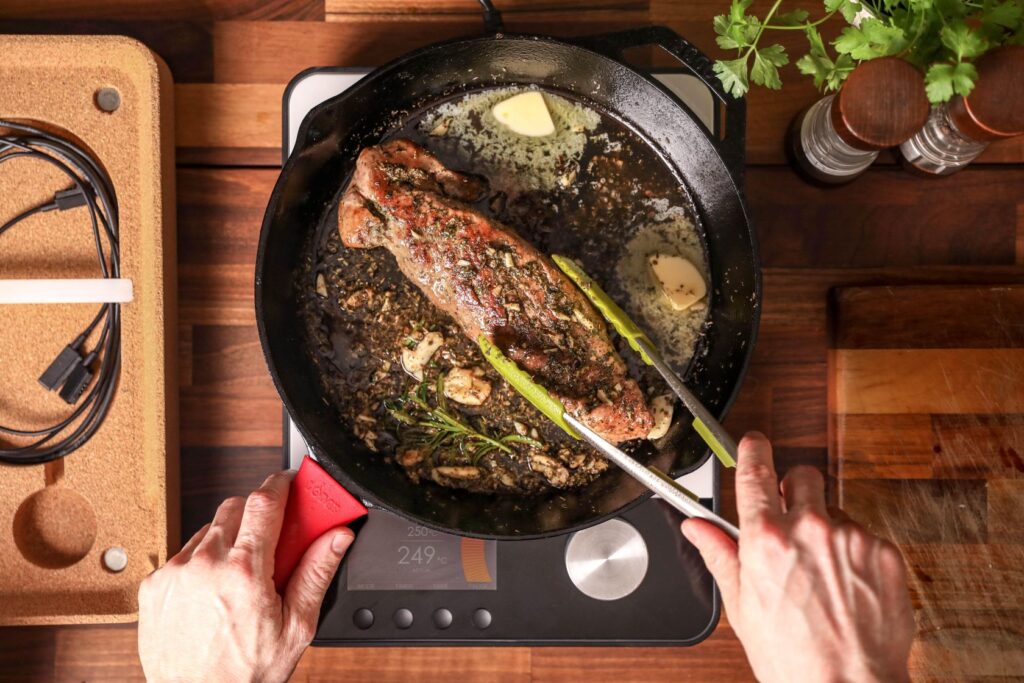
It packs a huge amount of culinary tech. A feedback loop enables the user to set and maintain a precise temperature for sous-vide, deep-frying, shallow-frying or slow-cooking.
Integrated scales allow you to weigh ingredients before and during cooking, as well as enabling users to reduce by a specific weight. An assortment of probes means you can test the temperature of the food itself, and and an ergonomic, magnetic dial lets you make delicate temperature adjustments that influence the food temperature rather than the cooking temperature.
Professional consistency
A key driver of innovation in kitchen smart tech is the desire for more accuracy and consistency amongst the growing ranks of adventurous home cooks.
The average kitchen has so many variables at play—hobs with clumsy power dials, pans made in various materials and thicknesses, ovens that take an age to reach temperature—that there is often a fine line between culinary success and a burnt failure.
Kitchen equipment manufacturers recognise the demand for precision. AEG has recently released its most advanced hob: the SensePro Induction Hob. Marketed as ‘the personal sous chef for restaurant-style results at home’, the hob includes a wireless food sensor that measures the core temperature of food and communicates adjustments to the hob, so that the user can sear steak, cook pasta or simmer a sauce in complete confidence. The only downside is the cost, with models starting at a hefty £1,400.
Sous-vide
If there’s one cooking technique that’s empowering adventurous home cooks to achieve the quality of dishes at home that were traditionally the preserve of professional kitchens, it’s sous-vide—the process of vacuum-sealing ingredients in a bag and then cooking at a precise temperature in a water bath.
Until the launch of the Anova Precision Cooker in 2014, sous-vide cookers were bulky and expensive. However, Anova’s sleek, easy-to-use, wand-like immersion cooker brought sous-vide to the mainstream and has started a boom that is spreading. Other technology companies are following suit, such as iVide with their 2.0 Sous Vide Cooker and Lakeland with their own-brand Sous Vide Wand.
Due to the fact the products are sealed away from the water and cooked at low temperatures, the nutritional content of the ingredients is preserved. This technique of cooking goes hand in hand with the shift we are seeing towards healthier, fresher cooking, also evidenced in the success of air fryers that use a fan mechanism to create the crisp effect of deep-fat frying but with a fraction of the oil.
Multi-functional equals mass-market appeal
If affordability is the greatest barrier to entry for most domestic chefs, then multi-functional products could be the game-changers that transform the quality of home-cooked meals over the coming years. Most are keenly priced and pack a lot of features into a small footprint.
The undisputed market leader of multi-functional products right now is the Instant Pot, which combines an electric pressure cooker, rice cooker, sauté pan and yoghurt maker in one handy unit that costs less than £100. Dishes that usually require several hours in the oven, such as slow-cooked pulled-pork, can be achieved without fuss, in a fraction of the time. It also consumes far less energy than a traditional oven.
Created by four former colleagues in Canada, the Instant Pot’s success is in part down to the designers’ attention to detail and quick reaction to customer feedback which has helped the smart cooker achieve something of a cult following across the world. Thanks to its community of websites, food bloggers who champion recipes, and books dedicated to exploring exciting new dishes to cook with the Instant Pot, the popularity of this multi-functional tool is only likely to grow.
During the last year we have seen people become more adventurous in their cooking. With lockdown resulting in restaurant closures, home cooks have been experimenting with new techniques and recipes in an effort to create the same level of culinary excellence they enjoy when eating out, and to relieve some of the boredom of lockdown.
The popularity of specialised food kits and delivery boxes has surged in the last 12 months and the sale of cookware was up by 40% in 2020 from the previous year. It seems domestic chefs have gained confidence and are looking to expand their repertoire, and equipment in the kitchen.
About the author
Nick Orme, co-founder of Njori. Njori designs smart, innovative kitchen tech for foodies who want professional, restaurant-quality results at home. The Njori Tempo is the first pack-away smart induction cooker that enables you to measure, monitor and regulate temperature to compose perfect meals, every time.
